


Eunice Naffie Mustapha, Ayesha Bintu Munu, Augustine Diction Bona
Introduction
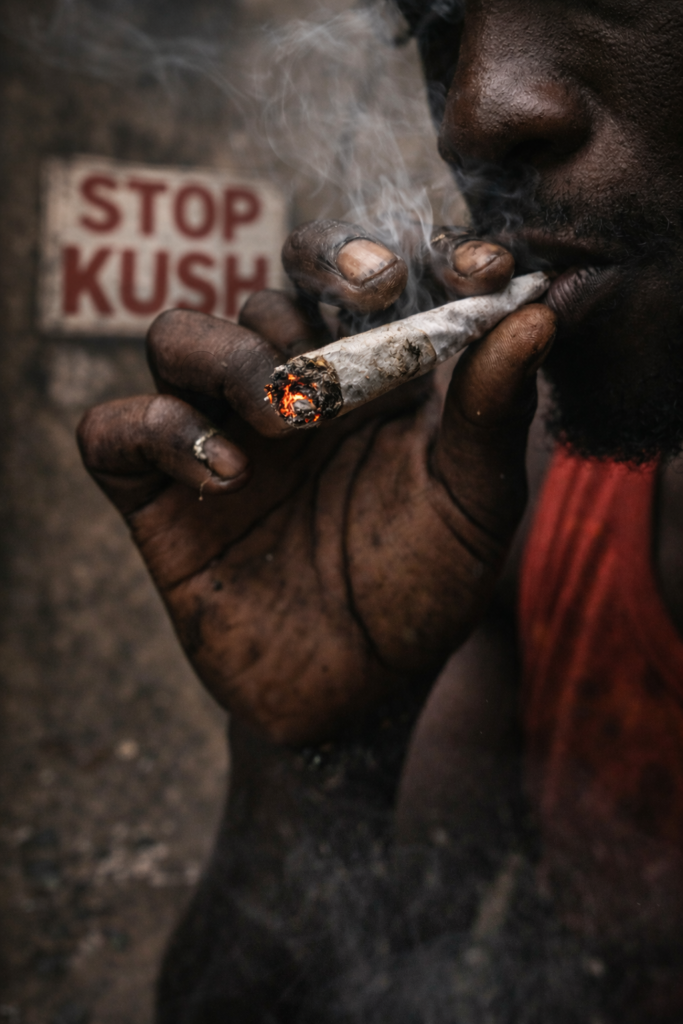
Sierra Leone is facing a serious public health crisis from the widespread use of highly addictive Kush, which is linked to numerous deaths [1]. This crisis adds to the country’s long history of public health challenges, including natural disasters, elevated maternal mortality rates, the Ebola outbreak and a prolonged civil war [1].
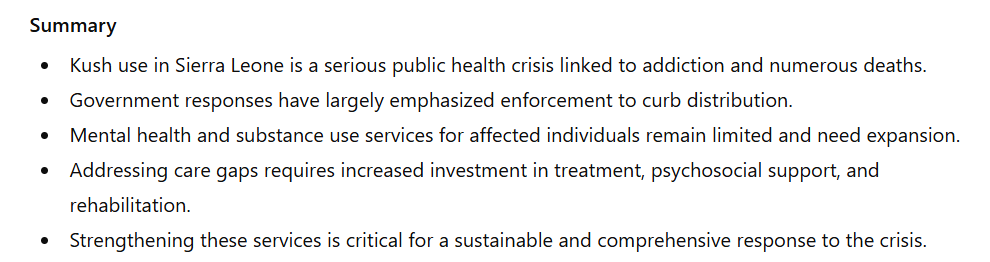
While government responses have largely emphasized enforcement measures to curb the circulation of Kush, the health and social needs of individuals affected by the substance remain pressing. Expanding mental health and substance use services, including clinical treatment, psychosocial support and rehabilitation, requires strategic investment. Addressing these care gaps is critical for a comprehensive and sustainable response to the Kush crisis.
This commentary briefly examines the Kush crisis in Sierra Leone and discusses care gaps in current responses.

Enforcement Measures vs. Care Gaps
Sierra Leone is currently the focal point for the distribution of Kush, a dangerous substance possibly associated with thousands of fatalities in West Africa [2]. In 2024, President Julius Maada Bio declared a state of emergency on substance abuse, citing concerns about the impact on young people, whom he described as the foundation of the nation [3]. The government also established a Special Security Unit to conduct raids, seize the substance and arrest perpetrators [4]. In 2025, practice direction issued by the Office of the Chief Justice of the Judiciary of Sierra Leone aligned the courts with the broader enforcement approach to tackling the drug crisis [5].
Although this commentary does not address the legality of such interventions, these responses illustrate the strong emphasis on enforcement in addressing the Kush crisis. While such measures may play a role in tackling drug trafficking and related criminal activities, they further underscore the need to complement enforcement with adequate investment in treatment and rehabilitation systems.
Research shows that Kush users often experience mental health challenges such as anxiety and depression [6]. Barriers to care, including inadequate healthcare services, unreliable estimates of mental health needs and critical shortage of mental health professionals, restrict access and undermine the right to health provided for in Article 16 of the African Charter on Human and Peoples’ Rights [6–9]. Mental health services in Sierra Leone are currently centered around the Sierra Leone Psychiatric Teaching Hospital in Freetown, limited psychiatric units and a small number of psychiatric nurses [8,9]. Some community mental health initiatives and civil society programs also provide psychosocial support and awareness activities, but overall service availability remains limited relative to the scale of need [8,9].
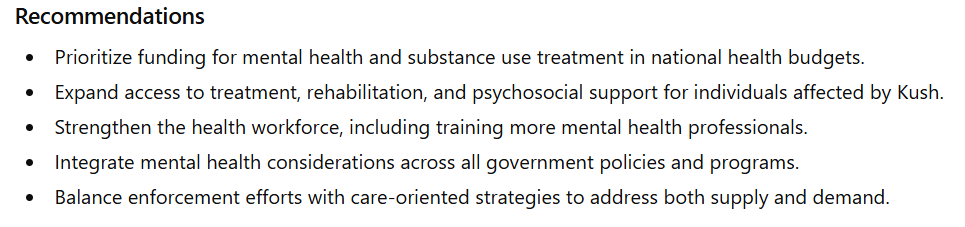
Shifting toward a more care-oriented response would require targeted investments in human resources, mental health screening, clinical treatment for substance use disorders, psychosocial support for affected individuals and rehabilitation services to support recovery and reintegration [9,10]. However, because funding is a major barrier for integrating mental health into service delivery, it is important that financing for Kush treatment is continuously prioritized as part of health sector budgeting decisions [8,11]. Funding decisions constitute a governance and policy responsibility, critical to maintaining continuity of care and essential health services. Integrating mental health considerations across all government policies, strategies and programs enhances collaboration, accountability and supports sustainable financing for mental health services [12].

Conclusion
The Kush crisis in Sierra Leone has prompted strong enforcement responses aimed at disrupting the supply and circulation of the drug. While these measures are important, they do not fully address the health and social consequences experienced by individuals affected by Kush use. As the crisis continues to affect communities, the need for accessible mental health and substance use treatment services becomes increasingly clear. Strengthening these services will require sustained attention to the financing of mental health systems, including investments in treatment, rehabilitation and recovery support. Highlighting these financing needs is essential for ensuring that responses to the Kush crisis address both enforcement priorities and the care needs of affected individuals.
Institutional Affiliations
- Eunice Naffie Mustapha, LL.B. Hons, B.L., LL.M., Research Affiliate, Georgetown University, emm353@georgetown.edu.
- Ayesha Bintu Munu, LL.B. Hons., B.L., Legal Practitioner, Marrah and Associates Law Firm.
- Augustine Diction Bona, BSc. Economics, LL.B. Hons., B.L., Legal Practitioner, Ace Legal Partners.
About Authors
The first author, who also serves as the corresponding author, is part of an emerging network of lawyers promoting health law and policy in Sierra Leone. The views and opinions expressed in this work are solely those of the authors and do not necessarily represent the official policies, positions, or views of their affiliated institutions.

Eunice Naffie Mustapha is a Health Lawyer and Policy Specialist who guides organizations in using laws and policies to advance optimal health outcomes.


Ayesha Bintu Munu is a Legal Associate who focuses on dispute resolution, drafting opinions, legal instruments and representing clients in civil disputes.


Augustine Diction Bona is a Corporate and Commercial Lawyer who brings a unique blend of legal expertise and socio-economic insight to his work.
AI Transparency Statement
The authors used AI-assisted tools for structural editing, clarity improvements and image generation. All included changes, such as substantive analysis and structural edits, were reviewed and approved by the authors.
References
- Tackling Substance Abuse: WHO Supports Efforts to Combat the Kush Epidemic in Sierra Leone. (2024). WHO | Regional Office for Africa. https://www.afro.who.int/countries/sierra-leone/news/tackling-substance-abuse-who-supports-efforts-combat-kush-epidemic-sierra-leone. Ibrahim Sahr Momoh (2025), Adult Men’s Health Needs and Access to Healthcare Services in Sierra Leone: Time to Consider Prioritising Men’s Health to Improve Outcomes in a Challenging Healthcare System. African Journal of Health, Nursing and Midwifery 8(1), 119-139. DOI: 10.52589/AJHNM2JAB2AHH
- Clingendael Institute, (2023). Kush in Sierra Leone: West-Africa’s growing synthetic drugs challenge and Europe’s and China’s part in it. Clingendael. https://www.clingendael.org/publication/kush-sierra-leone-west-africas-growing-synthetic-drugs-challenge-and-europes-and-chinas
- Sierra Leone declares national emergency after steep rise in use of deadly synthetic drug kush. (2024, April 6). CNN. https://edition.cnn.com/2024/04/06/africa/sierra-leone-emergency-kush-intl
- Special Security Unit Reports Progress In Nationwide Crackdown On Kush Dealers • Ministry of Information and Civic Education. Ministry of Information and Civic Education. (2025, November 6). https://moice.gov.sl/special-security-unit-reports-progress-in-nationwide-crackdown-on-kush-dealers/
- Chief Justice Issues New Directives on Drug Cases. Sierra Leone. (2025, December 3). https://www.africa-press.net/sierra-leone/all-news/chief-justice-issues-new-directives-on-drug-cases
- Ikoona, Eric and Namulemo, Lucy and Namulemo, Lucy and Kaluya, Ronald and Kaluya, Ronald and Vandi, Mohamed A. and Vandi, Mohamed A. and Sahr, Foday and Kitara, David, Lived Experiences and Recovery Challenges of Youth Facing the KUSH Crisis in Sierra Leone: A Qualitative Study. Available at SSRN: https://ssrn.com/abstract=5543304 or http://dx.doi.org/10.2139/ssrn.5543304
- African Union. (1981). African charter on human and peoples’ rights | african union. Au.int. https://au.int/en/treaties/african-charter-human-and-peoples-rights
- Jessica J Fitts, Fatmata Gegbe, Mark S Aber, Daniel Kaitibi, Musa Aziz Yokie, Strengthening mental health services in Sierra Leone: perspectives from within the health system, Health Policy and Planning, Volume 35, Issue 6, July 2020, Pages 657-664, https://doi.org/10.1093/heapol/czaa029. Psychiatric Teaching Hospital Earns Accreditation in Sierra Leone | Partners In Health. Www.pih.org. https://www.pih.org/article/psychiatric-teaching-hospital-earns-accreditation-sierra-leone
- Lahai, M., Vandy, A., Turay, A., Kolipha-Kamara, M. and Conteh, E. (2025), Synthetic Cannabinoids in Sierra Leone: Understanding the Use of ‘Kush’ Among Youths and Its Socioeconomic Impact in Sierra Leone and Sub-Region. Public Health Chall., 4: e70031. https://doi.org/10.1002/puh2.70031vernment-of-sierra-leone-launches-first-mental-health-champions-network/. Hopwood, H., Sevalie, S., Herman, M.O. et al. The burden of mental disorder in Sierra Leone: a retrospective observational evaluation of programmatic data from the roll out of decentralised nurse-led mental health units. Int J Ment Health Syst 15, 31 (2021). https://doi.org/10.1186/s13033-021-00455-1
- International standards for the treatment of drug use disorders: revised edition incorporating results of field-testing. Geneva: World Health Organization and United Nations Office on Drugs and Crime; 2020. License: CC BY-NC-SA 3.0 IGO
- Gendemeh, C. (2025). Integrating Mental Health into Community-Based Health Services: Motivational Strategies for Eradicating Kush Use Amongst Sierra Leonean Youth. International Journal on Science and Technology, 16(3). https://doi.org/10.71097/ijsat.v16.i3.8159
- WHO launches new guidance to promote mental health across all government sectors. Who.int; World Health Organization: WHO. (2025, November 24). https://www.who.int/news/item/24-11-2025-who-launches-new-guidance-to-promote-mental-health-across-all-government-sectors