


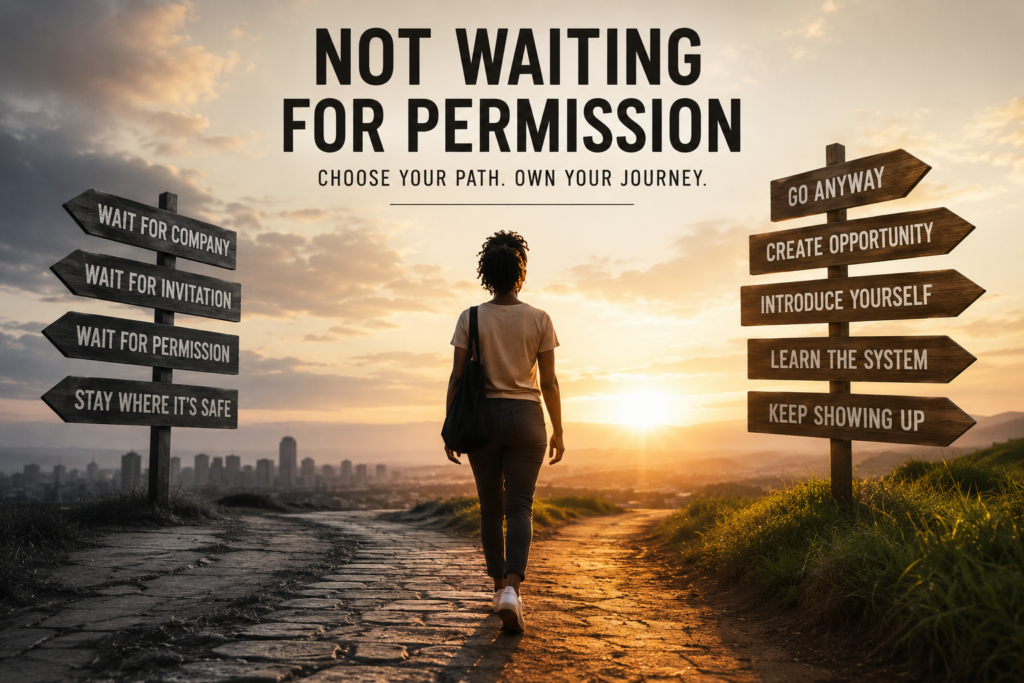
This morning, I find myself thinking again about two African women whose words have stayed with me long after they were spoken. Both conversations happened at different points in life, yet each carried the same quiet lesson about movement, independence, and how people often postpone experiences while waiting for ideal conditions.
The first is an East African lawyer I attended an event with in Ethiopia. I wanted to check out restaurants but kept procrastinating, waiting for others. She noticed this pattern and said, very simply, “If you cannot walk alone, you won’t go anywhere in life.” It was framed as an observation, a reflection of how easily people can delay their own movement in the absence of accompaniment.
The second is a Sierra Leonean academic doctor I spoke with. The conversation turned toward invitations and how access to certain spaces is frequently shaped by who is formally included, who is selected, and who is recognized. It is a familiar way people think about opportunity, as though participation must always be granted from the outside.
She laughed and responded, “If you are always waiting for invitations, you won’t go anywhere in life.” The point was not about exclusivity alone, but about how often people position themselves as passive recipients of access rather than active participants in it.
From these patterns, a few broader lessons about people and behavior emerge.
1. People often delay movement in the absence of companionship
There is a quiet tendency to postpone experiences that could easily happen alone, simply because they feel more meaningful when shared. Over time, this becomes a habit of waiting rather than doing, where simple decisions like going somewhere, trying something new, or stepping into unfamiliar spaces depend on someone else being available. Progress occurs when people stop rearranging their lives around company and begin acting on what is already possible.
2. People often misread access as something they must be selected for
Opportunity is frequently imagined as something granted from the outside, as though entry into spaces depends entirely on being chosen or formally invited. This thinking creates hesitation, where people position themselves at a distance from rooms they are already capable of entering. In practice, movement begins when people approach directly, apply without certainty, and engage without waiting for validation.
3. People underestimate how much presence is self-created
In many environments, visibility is not automatic. Waiting to be introduced often results in remaining unseen, not because there is a lack of value, but because presence was never actively made. Those who introduce themselves, initiate conversations, and clearly express their intent tend to be recognized more quickly, not through entitlement, but through visibility.
4. People struggle more with systems they have not studied
Structures exist in every field, whether professional, academic, or social, but they are often treated as opaque or random. This creates frustration when outcomes appear inconsistent or controlled by unseen forces. Yet most systems follow patterns. Those who take time to observe how decisions are made, how access flows, and how influence is distributed begin to navigate more strategically, rather than reactively.
5. People are shaped by what they repeat, not just what they intend
Many intentions remain incomplete because they are not repeated. One attempt rarely changes anything on its own. Progress is built through repetition, through continuing after silence, trying again after rejection, and staying in motion even when outcomes are delayed or unclear. Over time, repetition becomes the quiet structure behind visible change.
Looking back, what those two women offered me was not simply advice, but a reframing of how agency works in real life. They pointed toward a way of moving that is less dependent on permission, less constrained by waiting, and more rooted in the decision to participate fully even when conditions are uncertain. These lessons are not universal, and people may interpret or experience them differently, shaped by their own contexts, privileges, and limitations. However, they remain a reminder that in many moments, progress is less about what is granted and more about what is initiated, less about who opens the door and more about the willingness to walk toward it anyway.